


Key Takeaways:
- ERP vs CRM Core: SAP is built around enterprise operations and ERP control, while Salesforce is designed as a CRM-first platform focused on customer relationships.
- Business Fit: SAP suits large, process-driven enterprises, whereas Salesforce supports businesses of all sizes prioritizing sales, service, and marketing growth.
- CRM Experience: Salesforce delivers faster, more intuitive, and AI-powered CRM workflows, while SAP CRM aligns closely with structured ERP-driven processes.
- Deployment Speed: Salesforce enables rapid cloud deployment, while SAP implementations take longer due to deep enterprise system alignment.
- Integration Model: SAP excels at internal ERP integration, whereas Salesforce thrives in open CRM ecosystems with thousands of third-party integrations.
- Cost Structure: Salesforce offers lower upfront entry with subscription pricing, while SAP involves higher initial investment tied to licensing and customization.
- Hybrid Strategy: Many enterprises combine SAP for ERP operations with Salesforce for CRM to balance operational control and customer agility.
Digital transformation has rapidly reshaped how companies manage customers, streamline operations, and make data-driven decisions. In this shift, CRM and ERP platforms have become the backbone of modern businesses. Among the top platforms dominating this space, SAP and Salesforce stand out as global leaders often compared for very different reasons.
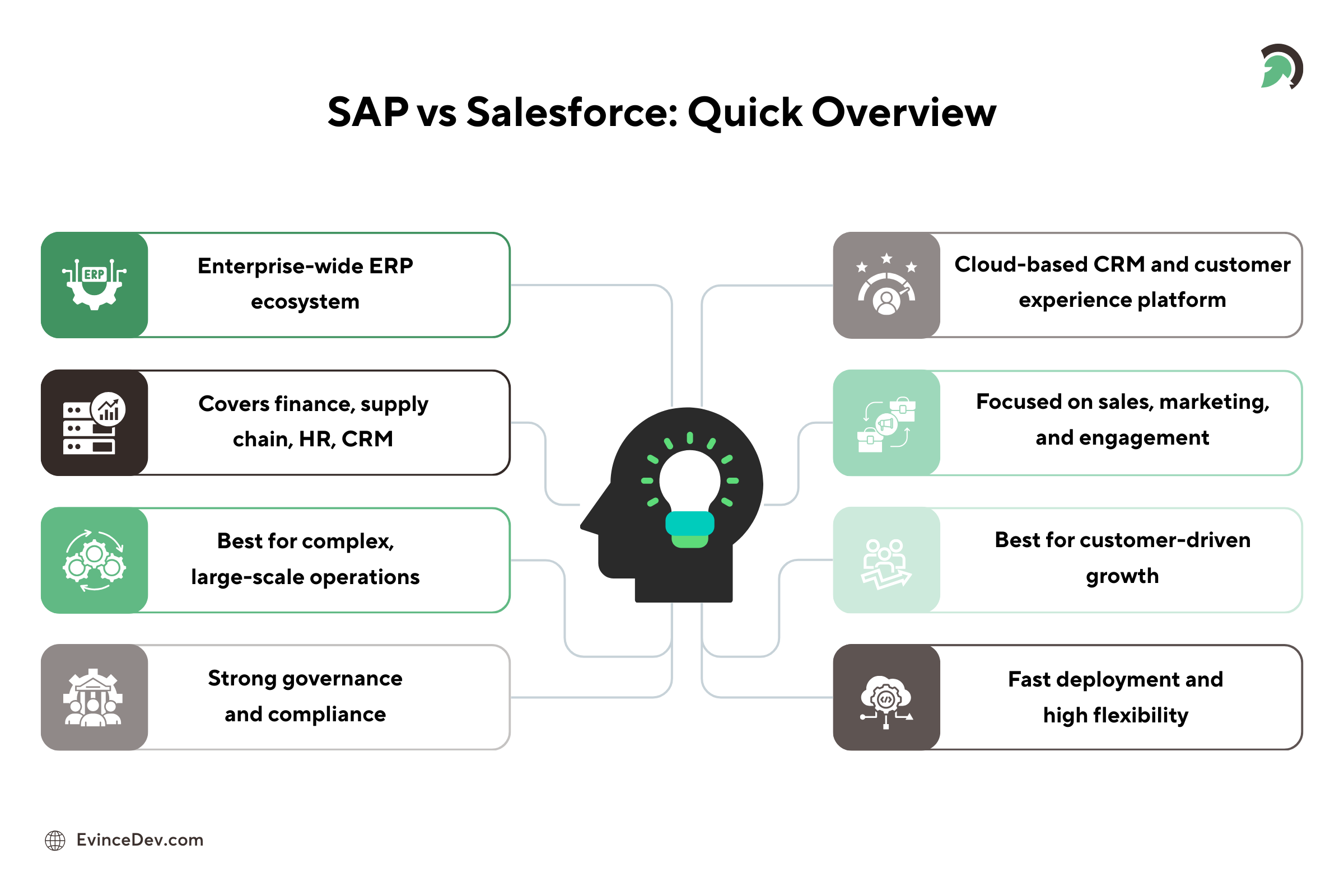
While both offer CRM capabilities, their core philosophies, strengths, and approaches differ significantly. SAP is known as a comprehensive enterprise ecosystem that covers ERP, supply chain, finance, HR, procurement, and CRM. Salesforce, on the other hand, is a pure-play CRM and customer experience platform focused on sales, service, marketing, digital engagement, and customer success.
Because both are widely used, organizations frequently ask which one suits them better. This blog aims to give you a complete, simple, and practical breakdown of SAP vs Salesforce to help you make the right choice for your business.
What Is SAP?
SAP, founded in 1972, is one of the most mature and respected enterprise software companies in the world. While many know SAP for its ERP system, the platform extends across almost every primary business function. SAP connects finance, HR, logistics, procurement, manufacturing, warehousing, inventory, analytics, and CRM into one unified environment.
This makes SAP ideal for companies that require standardized processes across business units, departments, and international locations. It excels in industries such as manufacturing, energy, automotive, logistics, pharmaceuticals, utilities, and large-scale retail, where process integrity and visibility are critical.
SAP CRM is often used by companies that already run SAP ERP because the integration between modules provides a single version of truth. Decisions made in procurement, manufacturing, supply chain, or finance are reflected immediately in CRM records, and vice versa. For businesses that depend on heavy operational control, this unified data structure becomes a strong advantage.
SAP’s approach is holistic. The tools are designed to manage both front- and back-office operations at scale. Companies that choose SAP are generally looking for stability, governance, compliance, and end-to-end process automation.
Quick Stat:
SAP’s scale is one of its biggest strengths. According to a Houlihan Lokey report, the company reportedly serves more than 440,000 customers across over 180 countries, highlighting its massive global footprint and deep presence in enterprise operations worldwide. This research explains why SAP is often the preferred choice for large, complex organizations seeking standardized processes and end-to-end visibility.
What Is Salesforce?
Salesforce is a cloud-native CRM platform launched in 1999 with the vision of simplifying how companies manage customer relationships. It became a pioneer of software-as-a-service and is credited with making cloud-based CRM mainstream. Over the years, Salesforce expanded into sales automation, marketing automation, customer service, commerce, analytics, and app development.
Unlike SAP, which began with ERP, Salesforce’s foundation is entirely customer-centric. Everything is designed to improve interactions throughout the customer journey. Salesforce offers products such as Sales Cloud, Service Cloud, Marketing Cloud, Commerce Cloud, Experience Cloud, Data Cloud, and the Salesforce Platform for custom app development.
The platform is highly flexible, user-friendly, and built for fast adoption. It is powerful across lead management, opportunity tracking, sales forecasting, service ticketing, customer engagement, email automation, conversational AI, and personalization. The AppExchange marketplace further boosts innovation by offering thousands of third-party apps and integrations.
Companies of all sizes widely use Salesforce. Startups like the ease of use and quick setup. Mid-sized companies value the automation and scalability. Enterprises love the flexibility and customer experience capabilities.
Its cloud-only approach means businesses can get up and running fast without worrying about infrastructure.
Quick Stat:
Salesforce has become a global frontrunner in the CRM space. According to Backlinko, between 2024 and 2025, Salesforce held about 20.7 percent of the worldwide CRM market share, making it the largest CRM provider globally. Its market dominance reflects the platform’s strong focus on customer experience, cloud innovation, and rapid adoption across businesses of all sizes.
SAP vs Salesforce
Although SAP and Salesforce each offer CRM features, the way they work, the value they provide, and the customers they serve differ across several areas. Let us compare them across the most critical business dimensions.

SAP vs Salesforce Key Differences Overview
-
Approach and Core Strategy
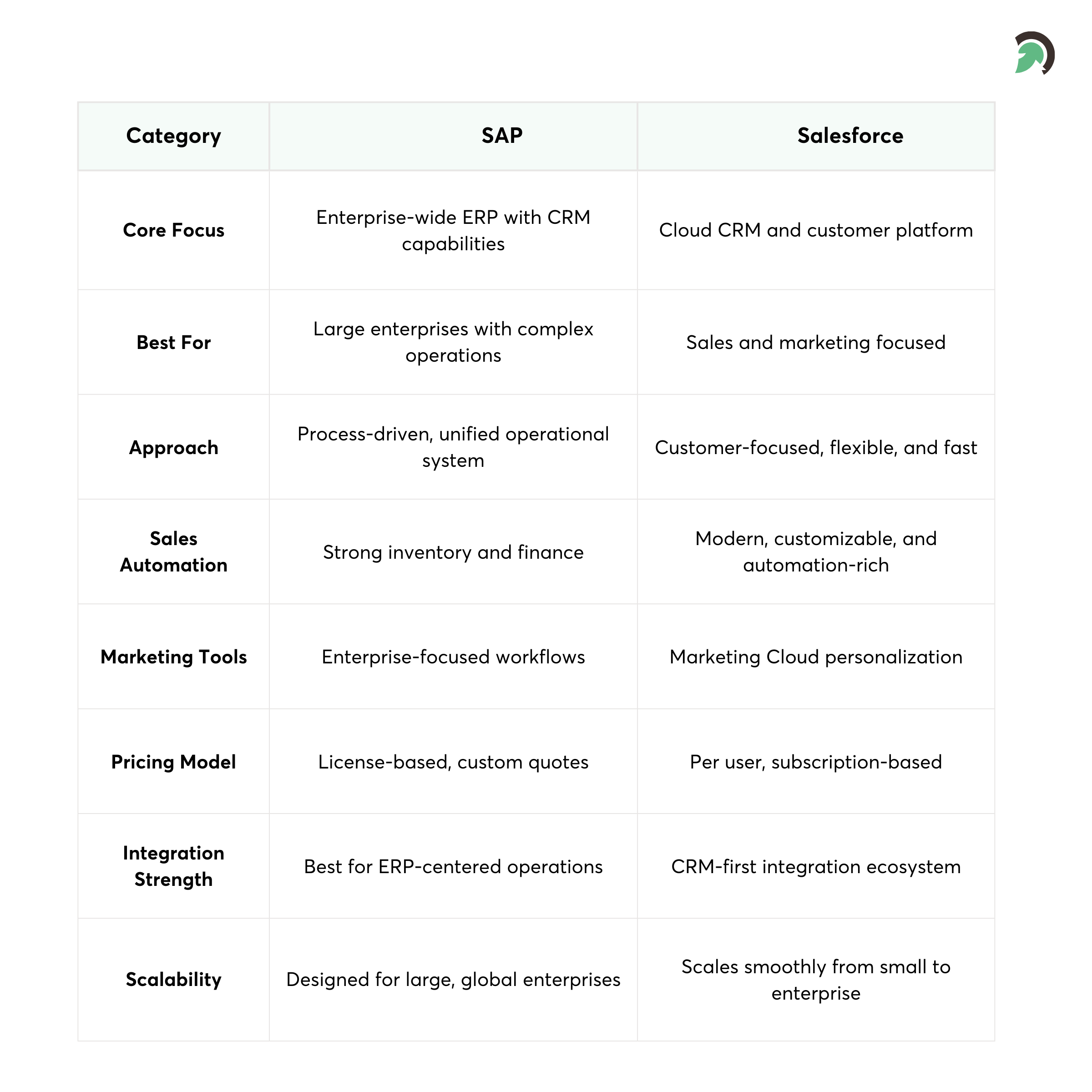
SAP follows a process-driven philosophy. Its main objective is to unify all operational functions, from procurement to customer service, so that the entire business runs on a single, structured system. SAP CRM is a part of this ecosystem. It shines most when all departments are connected and operating together. Salesforce focuses on customer engagement, sales performance, marketing effectiveness, and support operations. It aims to improve how businesses attract, convert, and retain customers. It is designed to be innovative, flexible, and fast to implement.
This fundamental difference often becomes the deciding factor. If your business wants operational depth and enterprise consistency, SAP stands out. If your priority is customer experience and accelerating revenue, Salesforce leads.
-
CRM Features and Capabilities
Salesforce offers intuitive lead nurturing tools, automated follow-ups, customizable pipelines, forecasting dashboards, and AI-based recommendations. Sales teams find the interface clean and easy to navigate.
SAP’s CRM helps manage leads and opportunities, but is more structured. It fits best when processes need to align with ERP data, such as inventory, order management, or supply chain workflows. -
Sales Automation
Salesforce excels with sales automation. Tools like automation rules, sequences, AI scoring, quote management, and real-time analytics help sales teams move faster. Its mobile app is strong too.
SAP CRM automation connects with inventory, pricing rules, purchasing, and manufacturing schedules. This helps companies dependent on external data from other departments.
-
Marketing and Customer Engagement
Salesforce Marketing Cloud is a powerhouse for customer journeys, email personalization, multi-channel campaigns, and AI content insights.
SAP offers marketing tools, but it is not as flexible or creative as Salesforce in this area.
-
Customer Service and Support
Salesforce Service Cloud supports omnichannel support, case management, knowledge base, chat, email, telephony integration, and chatbot support.
SAP Service supports customer issues well but integrates tightly with backend product, warranty, and service contract data, making it useful for industries with technical or product-driven support systems.
-
Integration and Ecosystem
The real value of SAP lies in its native integration between ERP modules. For example, a change in stock quantity affects order commitments, pricing, and customer communication instantly. Finance, HR, procurement, and CRM can work together within a single ecosystem.
This native connection helps reduce data duplication, increase accuracy, and improve coordination across departments. It becomes essential for large enterprises that need strict regulatory compliance and consistent data.
Salesforce thrives in an open ecosystem. AppExchange offers thousands of extensions for marketing, analytics, communication, finance, eCommerce, and more. The platform integrates smoothly with nearly every primary business tool.
While Salesforce does not have a native ERP, it integrates well with many leading ERP platforms, including SAP itself. This flexibility allows companies to mix and match systems based on preference.
-
Customization and Flexibility
Salesforce is known for its flexibility. It allows configuration through drag-and-drop builders, flows, workflow rules, custom objects, and low-code tools. Its development platform is robust and accessible, enabling businesses to build custom apps easily. This makes Salesforce ideal for changing processes, iterative improvements, and teams that experiment frequently.
SAP customizations require technical expertise, careful planning, and disciplined execution. While SAP is good, changes must fit within the broader ERP structure. This can lead to longer implementation cycles. SAP customizations are best suited for stable, long-term operational needs where compliance and process governance matter more than rapid agility.
-
User Experience and Adoption
Salesforce is widely recognized for its more straightforward interface and user-friendly design. Teams such as sales and marketing adapt to it quickly. Training is relatively straightforward.
SAP interfaces are more structured and take longer to master due to their complexity and feature set. This is natural because SAP is not only a CRM tool but an entire business management ecosystem.
-
Pricing and Total Cost of Ownership
Salesforce uses a per-user subscription model. This makes it easy to scale. Costs depend on the product suite and feature requirements. Initial setup costs are lower, but the overall cost can grow as more advanced functionality or additional modules are added.
SAP pricing depends on the combination of ERP and CRM modules, user licenses, deployment options, customization level, and long-term maintenance. Upfront costs tend to be higher, but for huge enterprises with many departments relying on SAP, the investment can be more efficient.
Architecture Overview: How SAP and Salesforce Work Under the Hood
Understanding the underlying architecture of SAP and Salesforce gives you deeper insight into how each platform functions, how data moves through the system, and why certain use cases suit one platform better than the other. Their architectural foundations influence performance, scalability, security, and integration methods.
-
SAP architecture: Modular and ERP Driven:
SAP is built on a modular architecture designed to manage complex enterprise processes across departments. Each module, such as finance, HR, logistics, procurement, or CRM, operates within a unified ERP core. These modules share a standard data model, enabling information to flow seamlessly across the system without duplication.
For example, when inventory levels update in the logistics module, that data is immediately available to CRM, finance, and procurement. This level of connected architecture is valuable for large enterprises where operational accuracy and process alignment matter.
Modern SAP systems, such as SAP S/4HANA, also run on in-memory databases that enable real-time processing and analytics. This gives SAP an advantage in environments that depend heavily on accurate operational data and complex business logic.
-
Salesforce Architecture: Multi-Tenant Cloud Platform:
Salesforce operates on a cloud native, multi-tenant architecture. Multi tenancy means all customers run on shared infrastructure while maintaining complete data isolation. This design enables upgrades, maintenance, and new feature releases to occur much faster, since Salesforce updates the entire cloud environment at once.
This architecture also enables high scalability, allowing businesses of any size to use the same underlying platform. Salesforce handles all infrastructure, servers, and hosting, reducing companies’ technical workload and speeding up deployments.
Salesforce’s metadata-driven framework allows businesses to customize applications without impacting the underlying code. This is one of the reasons Salesforce is known for its flexibility and rapid development capabilities.
-
Data Workflows and Storage Differences:
SAP stores data within its structured ERP environment, ensuring consistency across all modules. Data moves through predefined processes connected to supply chain, finance, and operational workflows. This is ideal for enterprises that need strict governance, compliance, and accuracy across business functions.
Salesforce stores data in its cloud environment using an object-based model. Information is organized into objects such as leads, accounts, opportunities, or cases, and can be extended through custom objects. Data flows rapidly across automation rules, workflows, and integrations, enabling businesses to design customer experiences with high agility.
Because of this difference, SAP is stronger for operational data consistency, while Salesforce is stronger for customer data flexibility.
-
Security Approach in SAP vs Salesforce:
Both platforms are highly secure but offer different security models based on their architecture.
SAP focuses on enterprise-grade governance. It provides detailed access controls, audit trails, compliance features, and integration with company-wide identity systems. Industries with strict regulatory requirements, such as manufacturing, healthcare, government, and finance, commonly choose SAP.Salesforce uses a cloud native security model with encryption, tenant isolation, identity management, and layered security controls. Since Salesforce handles all patching, monitoring, and infrastructure security, businesses experience a reduced administrative burden while still receiving enterprise-level protection.
In simple terms, SAP emphasizes internal control and governance, while Salesforce emphasizes secure cloud delivery and global availability.
SAP vs Salesforce: Complete Side-by-Side Comparison
Comparison tables help readers quickly understand differences and improve search visibility for technical and commercial queries. Below are clear tables covering features, pricing factors, deployment, integration, and customization.

Complete Comparison Between SAP and Salesforce
Which Platform Should Your Business Choose?
Choosing between SAP and Salesforce depends on what your company values most.
Choose SAP if
- Your business has complex operations
- You want one unified enterprise system
- You rely heavily on ERP functions
- You need deep compliance or regulatory control
- You already use SAP in multiple departments
SAP is best for structured enterprises where operational processes are the core of the business.
Choose Salesforce if
- You prioritize customer experience and sales growth
- You need fast deployment
- You want flexibility and easy customization
- You run data-driven marketing and customer support
- You expect rapid scaling in the next few years
Salesforce is ideal for companies that want to boost sales, marketing, and customer service with modern digital tools.
Hybrid Approach
Some enterprises use SAP for ERP and Salesforce for CRM. This combined approach offers the operational strength of SAP with the customer-centric flexibility of Salesforce.
Market Trends and the Future of SAP vs Salesforce
The software landscape is shifting toward AI-powered platforms, data unification, and cloud-first operating models. Salesforce is pushing strongly into AI CRM with tools like Einstein AI, conversational intelligence, automated content generation, and predictive sales analytics. It is positioning itself as the intelligent customer platform of the future.
SAP is expanding its S/4HANA ecosystem to bring real-time analytics and AI into large-scale operations. It is also strengthening its Data Cloud and industry-specific solutions to stay competitive across global enterprise systems.
Common Misconceptions About SAP and Salesforce
-
Misconception 1: Salesforce is only for small businesses
In reality, Salesforce is used by Fortune 500 companies across healthcare, finance, retail, and technology. It scales extremely well.
-
Misconception 2: SAP CRM is outdated
While older versions were less flexible, modern SAP CRM and cloud-based versions remain powerful and tightly integrated with SAP ERP.
-
Misconception 3: SAP and Salesforce cannot work together
Many enterprises integrate both platforms to combine operational efficiency with customer-centric agility.
-
Misconception 4: One system works best for every business
The right choice always depends on use case, sector, size, and digital maturity.
Conclusion
Both SAP and Salesforce are powerful platforms, but they serve different purposes. SAP is the right choice for enterprises that need a unified, end-to-end operational ecosystem supported by ERP, supply chain, finance, and HR. Salesforce is the right choice for companies that want to modernize customer engagement, sales processes, support operations, and marketing strategies. The best decision comes from understanding your organization’s priorities, growth plans, and level of operational complexity. If your business is built around customer-driven growth, Salesforce will help you accelerate it.
If your business depends on operational excellence and enterprise-wide control, SAP is likely the better fit. To make the decision easier, EvinceDev can support you with requirement discovery, platform comparison, and a practical roadmap for successful adoption.